Eleven musicians on one stage, two completely different sonic worlds: a classical ensemble with two opera voices, strings, organ and piano – and two musicians from a jazz background weaving improvised jazz-electro, built from a mix of analogue and digital electronics, in and out of the classical sections. Not a DJ set – jazz-electro. For the WeLive episode "Classic meets Electro" at Parktheater Lahr, we recorded the whole evening as one continuous take and mixed and mastered it afterwards. Not a studio production with unlimited takes, but a real, one-off live evening that had to hold up as a recording.
At a Glance
- Role: punchline studio
- Direction, camera, production, editing, colour grading, mixing & mastering
- Team
- Maik & Pirmin Styrnol (direction), Raphael Federer (cinematographer), Adrian Schaub / Schaub Licht & Ton (live audio recording)
- Ensemble
- 11 musicians & singers – opera, strings, organ, piano, live electronics
- Format
- WeLive on Tour – "Classic meets Electro"
- Location
- Parktheater Lahr
- Premiere
- July 25, 2021
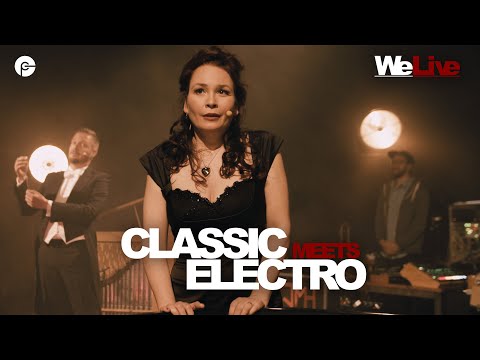
An Evening Between Classical Blocks and Jazz-Electro Interludes
The concept: classical works – some solo, some opera arias – alternate with improvised jazz-electro pieces that lead into or out of the classical sections. The line-up keeps shifting throughout, from solo instruments to a string quintet and chamber organ to the full ensemble for the finale. The running order isn't fixed either: sometimes the classical version opens a block and the jazz-electro version closes it out, sometimes it's the other way round. Over the course of a good 78 minutes, seven classical works came together, from Bach to Gershwin:
- J. S. Bach – Cello Suite No. 2, Prélude: solo cello (Andrej Melik), immediately followed by "Cello Suite Remixed" as a solo trumpet reworking by Julian Maier-Hauff
- J. S. Bach – Mass in B minor: "Laudamus te" and "Agnus Dei", string quintet and chamber organ accompanying Cornelia Lanz solo
- "Figaro Remixed" (jazz-electro duo Julian Maier-Hauff & Konrad Hinsken) opening into two arias from Mozart's "Le nozze di Figaro" plus "Il Core Vi Dono" from "Così fan tutte", each accompanied on piano
- "Black Earth Remixed" (jazz-electro duo) opening into Fazil Say's "Black Earth (Kara Toprak)" for solo piano (Anzhelika Kovalenko)
- "Carmen Remixed" (jazz-electro duo) opening into four numbers from Bizet's "Carmen" (among them the Habanera, the Seguidilla, the Chanson Bohème), accompanied on piano and by the string quintet, sung by Cornelia Lanz
- Gershwin (arranged by Konrad Hinsken) – "Summertime" from "Porgy and Bess" as a joint finale: piano, jazz keys, saxophone, string quintet and vocals together
Four of the seven works got their own jazz-electro companion piece; three stayed purely classical – and only three of those jazz-electro pieces (the Figaro, Black Earth and Carmen reworkings) were actually played as a duo by Julian Maier-Hauff and Konrad Hinsken. The opener, "Cello Suite Remixed", was instead a solo piece for Julian Maier-Hauff on trumpet. For the mix, that means: not a single stylistic jump-cut, but an entire evening of transitions between shifting line-ups and two different sonic languages – and every single one of them had to hold together.
The Line-Up: Eleven Musicians Between the Opera Stage and Jazz-Electro
The vocal parts were sung by mezzo-soprano Cornelia Lanz and baritone Menno Koller. They were joined by a string ensemble – Elisa Schrape (leader/solo violin), Claudia Bühler and Anke-Bettina Melik (violin), Tigran Hakhumyan (viola), Andrej Melik (cello) – plus a chamber organ kindly provided by the Evangelisches Bezirkskantorat Lahr, and a grand piano played by Ukrainian pianist Anzhelika Kovalenko, who accompanied the Mozart and Bizet blocks on piano in addition to her own solo piece. Live electronics came from Julian Maier-Hauff (electronics, trumpet, sax) and Konrad Hinsken (electronics, keys), who also wrote the Gershwin arrangement for the evening – both come from a jazz background and worked accordingly, improvising with a mix of analogue and digital electronics rather than a pre-produced DJ set.
The Technical Challenge: Two Sonic Worlds in One Continuous Take
Opera voice, strings, organ, piano and improvised jazz-electro electronics cover an enormous sonic range that typically doesn't sit together – and that's exactly what had to work in the mix regardless, without either side playing second fiddle.
The core principle was locked in before a single microphone went up: the entire signal chain was built for the recording, not for reinforcing the room for the audience in the seats. A PA is optimised for the room in that moment; a good recording has to hold up over headphones or speakers at home – trying to serve both at once almost always costs the recording something. Adrian Schaub of Schaub Licht & Ton captured the full multitrack signal on site; mixing and mastering then happened afterwards at punchline studio.
The second wrinkle: Julian Maier-Hauff and Konrad Hinsken brought their electronic elements already roughly pre-balanced themselves – they'd shaped the internal balance of their own setup in advance. Even so, every element still arrived as its own individual feed straight into the desk, rather than as a finished stereo bus. In the mix, that meant we still had real access to the individual electronic elements even though the artists had already set a first balance themselves – a middle ground between a fully raw multitrack recording and a finished stereo feed.
And third: the transitions between the jazz-electro pieces and the classical blocks weren't built in the edit – they were played live, like a genuine live performance, with no second take to fix anything. In the mix, that meant handling the huge dynamic-range gap between opera voices, strings and organ on one side and compressed electronic production on the other, so both sonic worlds could sit side by side in the same continuous mix – without an audible flip at the transition.
The Crew
Maik and Pirmin Styrnol co-directed, with Pirmin Styrnol also handling on-site production; Raphael Federer served as cinematographer (director of photography). Raphael Baumann and Franz Weber also worked camera. The concept for the stage design and set came from Maik and Raphael Federer; on-site execution was handled by a larger team – Wolfgang Richter, Taner Demiralay, Peter Jehle, Manuel Ehrhardt and Kevin Derday, supported by the venue's in-house technical staff – all overseen by direction and cinematography, as on any film set. Live audio recording on site was handled by Adrian Schaub of Schaub Licht & Ton; editing, colour grading and mixing & mastering were then completed at punchline studio.
The result is a recording that serves two audiences at once: tune in for the opera voices, and you get clean, untouched arias. Tune in for the electronics, and you get an improvised jazz-electro take on the same works. And listen to the whole thing, and you get one continuous mix that never had to choose between the two – exactly the kind of mixing & mastering where unconventionally recorded, seemingly mismatched sonic worlds have to be fused into a single whole.
Partners & Supporters
"Classic meets Electro" was produced as part of WeLive on Tour, funded by the Innovationsfonds Kunst 2021 of the state of Baden-Württemberg. The chamber organ was kindly provided by the Evangelisches Bezirkskantorat Lahr.
What This Means for Your Project
This episode shows how we approach mixing & mastering projects that don't fit into a single genre: not smoothing everything into sameness, but treating each sonic world the way it actually needs to be treated. That same care with very different signal sources in one project goes into every mixing & mastering job we take on. And if you've got a live multitrack recording that needs mixing, that's the bread and butter of our live recording mixing.
Frequently Asked Questions
Does your project bring two sonic worlds together?
Acoustic and electronic, classical and modern, or just an unusual combination – we bring it together in one mix, without smoothing either side away.