A common rule for live recordings goes like this: the room is part of the concert, so it belongs in the recording. For classical music, that's true. For bands, we usually see it differently. A club, a hall or a rehearsal room sounds alive to the people standing in it. In a recording you'll later hear on headphones, the same room quickly becomes a problem: it smears the transients, eats clarity and sticks to every single track.
That's why we mix bands close and direct, even on live recordings. We take the room of the night out as far as we can and rebuild it in the mix, under control. Here's what that looks like in practice, using an extreme case: the concert film we shot with Attila Reißmann for our WeLive series in a former NATO bunker in Lahr.
The extreme case: a concrete room with flutter echo
We filmed in a single, fairly narrow room: bare concrete, box-shaped, parallel walls. Acoustically, that's about the opposite of a concert hall. Between parallel hard surfaces, sound bounces back and forth and creates flutter echo, a fast, metallic “brrr” after every transient. You hear it most clearly on the snare and on consonants in the vocals.
Add to that the lack of space. A band, gear and cameras on a few square metres means every mic hears everything. The vocal mic picks up cymbals and the guitar amp, the overheads pick up the bass, the tom mics pick up the snare. And everything a mic catches from another instrument comes with the room's flutter echo attached.
You can't simply turn a room like that down in the mix. De-reverb tools can reduce part of the room sound, but the harder you push them, the more artefacts you get, and flutter echo with its periodic reflections is a particularly stubborn case. So the most important decision happens before the mix.
1. The decision happens at the recording stage
Our rule: as much direct signal and as little room as possible on every track. In the bunker, that meant:
- Close-miked drums. Every drum gets its mic right at the source. The closer the mic, the bigger the gap between direct signal and room.
- Acoustic guitar via DI. A DI signal has no room and no bleed at all. In the bunker, it was the cleanest option for the acoustic guitar. The price: it sounds like a pickup, not like a guitar. More on that below.
- Hardly any room mics. In a good hall, we use room and audience mics deliberately. In a concrete room with flutter echo, they'd capture exactly what we don't want. So: minimal or none.
It's also something to agree with front of house. In the bunker, Lars Hummel did the live sound. Whatever is loud on stage ends up on every track. The quieter the stage, the cleaner the recording: in-ear monitoring instead of loud wedges, and amps no louder than they need to be, help the mix more than any plugin.
2. Reducing bleed: machine learning instead of gates
The classic answer to bleed used to be a gate: below a threshold, the track is muted. On live recordings, that has two problems.
First, the bleed is often almost as loud as the signal you want. A cymbal in the vocal mic or a snare in a tom mic sits too close in level for a threshold to separate them cleanly. The gate chatters, opens at the wrong moment or cuts off decays.
Second, a gate is binary: open or closed. When it's open, all the bleed, room included, is back, exactly when the instrument is playing.
So these days we rarely use gates and expanders, only when a track is already very well separated from the rest. Most of the work is done with tools based on machine learning, mainly iZotope RX. They recognise what belongs to a voice or an instrument and reduce the rest, even while the instrument is playing. A cymbal in the vocal mic gets quieter without the vocal sounding gated.
It's not without compromise. Take out too much and you'll hear artefacts quickly: a slightly “watery” sound, gaps in decays. That's why we work in stages and listen to every track in context with the rest, not soloed. The goal isn't zero bleed, it's enough less bleed that the mix is back under control.
3. The DI acoustic guitar: getting the body back
An acoustic guitar via DI is practical live: no feedback, no bleed, no room. It rarely sounds nice, though. A piezo or pickup signal is often spiky, a bit nasal, and has little of what makes a guitar a guitar: the body, the air, the resonance of the wood. EQ alone hardly brings that back.
For cases like this, we've done something fairly crazy more than once, and it works surprisingly well: in the studio, we play the DI track through a mono speaker, put a real guitar right in front of it and mic up that guitar. The speaker excites the top and the body, the guitar resonates along, and the mics capture exactly what the DI signal is missing: the body.
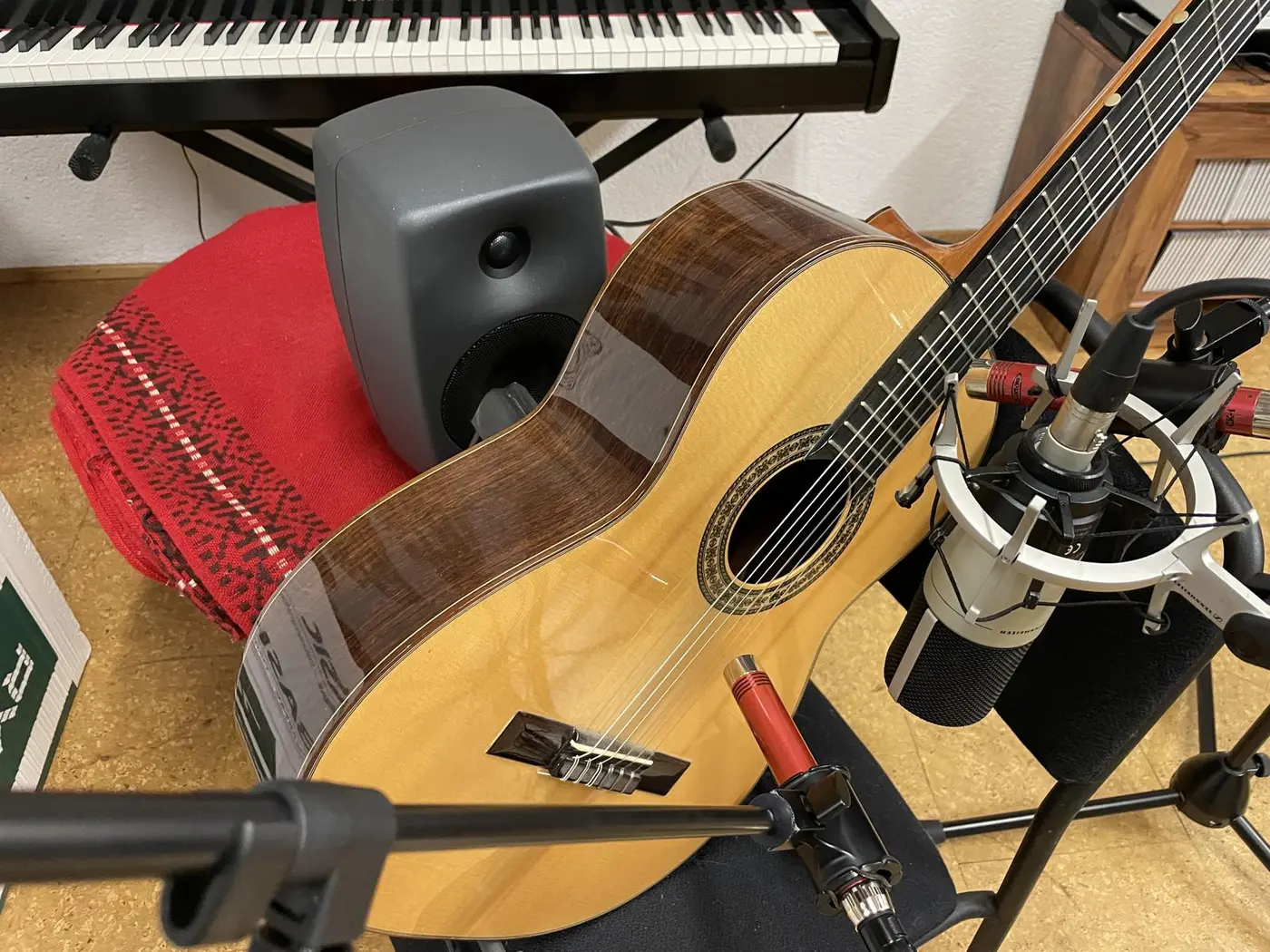
In the mix, this signal is blended in with the DI. A few things to watch out for:
- Correct the timing: the mic signal travels speaker, guitar, mic and arrives later than the DI. Without alignment, you'll get comb filtering. Auto-Align helps here too.
- Blend, don't replace: the signal adds to the DI, it doesn't replace it. A surprisingly small amount is often enough to make the guitar sound like wood again.
- Keep the playback level down: too loud, and the guitar's strings start ringing audibly or things rattle. Experiment with distance and level.
4. Aligning phase and timing
When several mics hear the same instrument from different distances, the signals arrive at different times. That costs punch and low end, especially on kick, snare and overheads.
So we align the key track groups with Auto-Align, fresh for every recording. Mic positions are different with every setup and sometimes even change during the show when someone knocks a stand. Settings from an earlier project won't automatically fit.
5. Supporting the drums where the room took too much
Even with close miking, a snare or kick can sound thin or too roomy in a difficult space. Then we support it with samples, triggered from the original track, in our case with Addictive Drums.
The key word is “support”. We don't replace the drum, we blend the sample in with the original. The original stays in charge and carries the dynamics, ghost notes and feel. The sample only adds what the room took away. That way it stays a live recording. And we only do it when it's needed, not as standard.
6. Rebuilding the room
Once the real room is largely gone, a live recording sounds dry at first, almost like a studio recording. That's the point where we give the room back, but this time one we choose: artificial reverb that suits the song, and enough depth that the band sounds like a band in a room rather than five separate tracks.
From here on, we mix a live recording much like a studio album: with all the usual plugins and a few that have proved themselves over the years, such as Pulsar Modular for tape saturation, and with outboard gear. It doesn't have to be expensive: we use Warm Audio recreations, the EQP-WA in the style of a Pultec, the WA76 and WA-2A compressors, the Bus-Comp on the mix bus and WA273 preamps in the Neve style, plus dbx compressors. Affordable, but absolutely good enough for the job.
We treat the audience separately. Applause and reactions come from their own mics, where available, and are used deliberately between songs, not as a constant carpet under the music.
The exception: classical music
With orchestras, choirs, chamber music or piano, all of this is reversed. There, the room is part of the instrument. A grand piano in a good hall sounds great not despite the room but because of it. Here we don't take the room out; we choose the miking so that it ends up on the recording in the right balance, usually with a main mic array and a few spot mics. More on that in Recording an orchestra: stereo or multichannel?
Checklist for recording in difficult rooms
- Listen to the room first: a single clap is enough. If you hear a fast “brrr”, you've got flutter echo.
- Mics as close to the source as possible, room mics only if the room sounds good.
- Record instruments with pickups via DI as well. It costs nothing and can save the mix. With acoustic guitar, you can bring the body back later with the speaker trick.
- Turn the stage down: in-ears instead of loud monitors, amps no louder than needed.
- Record everything as multitracks, not just the desk mix. How to do that on a digital desk: Exporting multitracks from a digital desk.
- If you can, record a few seconds of silence: it makes it easier to treat noise floor and room later.
In short
A difficult room is no reason to skip a live recording. It just shifts the work from capturing the room to controlling it: close miking, reducing bleed instead of gating, giving the DI guitar its body back, aligning phase, supporting drums only where needed, and finally building a room that suits the song.
To see and hear the result, watch the concert film from the bunker: Bunker Concert: WeLive in Lahr's NATO bunker.
Frequently asked questions
Got a live recording from a difficult room?
Send us your multitracks or tell us briefly what you recorded. We'll tell you honestly what's possible.
Live recording mixing